the home building and renovation landscape will be influenced by the growing adoption of smart home technologies. From electric vehicle (EV) chargers to solar panels, modern households are far more power-hungry than before. As a result, electrical wiring costs have soared, leaving homeowners searching for ways to optimise their budgets.
Why is electrical wiring estimation so crucial? Planning and estimating wiring accurately can help you save 10-20% on your overall budget. Beyond cost savings, adhering to safety standards such as the National Electrical Code (NEC) ensures compliance, prevents fines, and avoids potential hazards. In this guide, we’ll break down each step of the estimation process while keeping safety, efficiency, and cost-effectiveness in mind.
Why Accurate Estimation Matters

Accurate electrical wiring estimation is not just a numbers game—it’s the foundation of a successful project. Here’s why it’s essential:
- Avoid Project Delays and Cost Overruns: Poor planning can lead to unexpected expenses, especially when wiring costs range from $5 to $12 per square foot for new homes.
- Prevent Overloading: By identifying load requirements early, modern home setups incorporating EV chargers, solar panels, and smart devices can prevent circuit overloads and ensure smooth operation.
- Empower DIYers and Professionals: Whether you’re a homeowner or a contractor, accurate estimates enable confident bidding and decision-making.
Tools and Materials Needed
Before diving into the estimation process, you’ll need to gather the proper tools and materials. Having the right equipment ensures accuracy and efficiency throughout the project.
Essential Tools
- Blueprints and Floor Plans: These help map out circuits, outlets, and fixtures.
- Calculator or Estimation Software: Use tools such as Electrical OM or spreadsheets to track quantities.
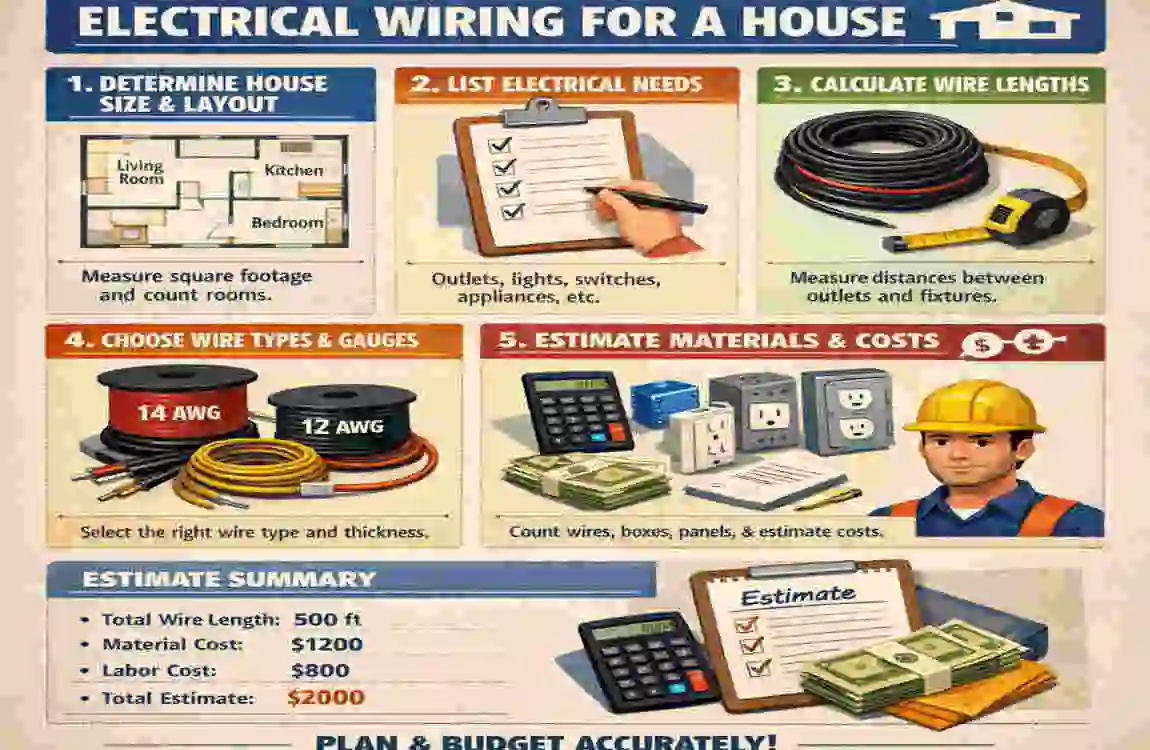
- Voltage Drop Charts and Wire Gauges: Common gauges include 12-14 AWG for standard circuits.
- Measuring Tools: A tape measure or laser measurer for precise wire lengths.
Materials Checklist
- Conduits and Fittings: PVC or EMT conduits for wire protection.
- Breakers and Panels: Standard breakers range from 15-20 amps, with panels typically rated at 100-200 amps.
- Wires and Cables: PVC-insulated copper wire is a popular choice, with categories based on use (e.g., 2.5 mm² for lighting, 4 mm² for power).
- Buffer Stock: Always account for 10-15% extra material to cover wastage from cuts and bends.
Step-by-Step Guide to Electrical Wiring Estimation
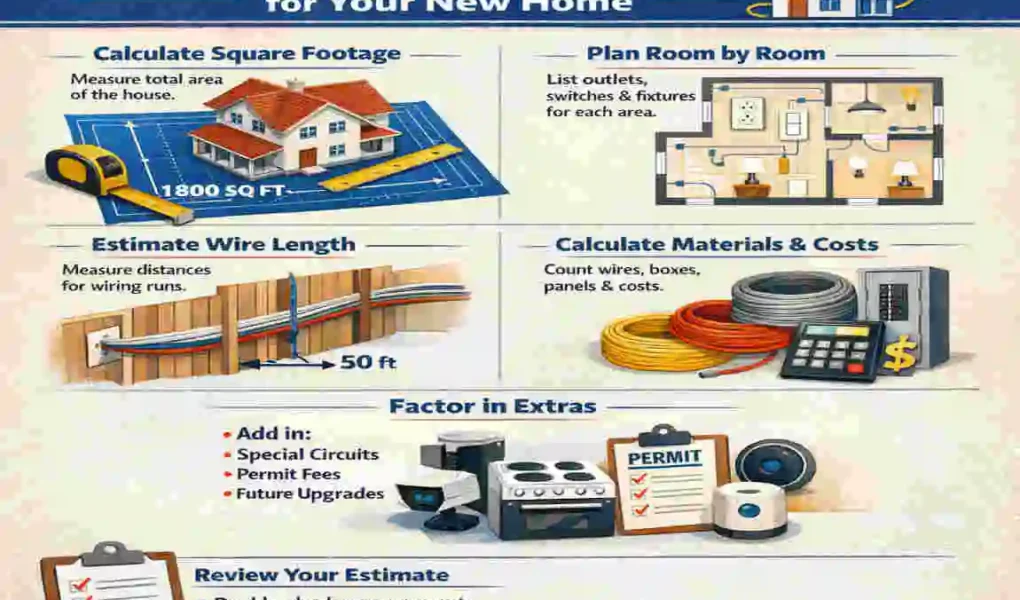
Step 1: Assess House Layout and Load Calculation
The first step in your estimation journey is understanding the luxury house‘s layout and calculating the total electrical load.
- Analyse Floor Plans: Map out each room, noting the locations of outlets, lights, and large appliances. A general rule is to allocate one outlet per 12 square feet.
- Estimate Load Requirements:
- Lighting: Approx. 3 watts per square foot.
- Outlets: Allocate 180 VA per outlet.
- Kitchen Appliances: Up to 8 kW for major appliances.
- Panel Sizing: Divide total load into continuous (e.g., lighting) and non-continuous (e.g., appliances). For most modern homes, a 100-200 amp panel suffices.
Determine Circuit Requirements
Next, plan your circuits. This involves grouping electrical points into sub-circuits based on their usage.
- Standard Circuit Ratings:
- 15A for lighting and ceiling fans.
- 20A for outlets and general-purpose circuits.
- 30-50A for heavy appliances like dryers and ovens.
- Point Count: For a 2,000 sq ft home, you might need 20 outlets and 15 light points.
- Efficient Circuit Design: Use a looping method—connecting multiple points on a single circuit—to reduce wiring needs by up to 20%.
Calculate Wire Lengths
Measuring wire lengths accurately is critical for both budgeting and ensuring you don’t run out of materials mid-project.
- Estimate Phase and Neutral Wires:
- Add 20% extra for vertical drops (common in homes with 3-4 meter ceilings) and bends.
- Earth Wire Calculation: Typically, this is half the length of the phase wire.
- General Rule of Thumb: Allocate 1.5-2 feet of wire per square foot of floor area. For a 2,000 sq ft home, expect to need around 3,000-4,000 feet of wire.
Select Wires, Conduits, and Accessories
The type of materials you choose plays a major role in both cost and durability.
Wire Selection
- PVC-Insulated Copper Wires: Opt for 2.5mm² for lights and 4mm² for power circuits.
- THHN Wires: Ideal for concealed installations due to their heat resistance.
Conduits and Accessories
- 25mm PVC Conduits: For surface wiring.
- EMT Conduits: For concealed wiring in walls.
- Accessories: Include MCBs (10-32A), DBs, and sockets (5-15A).
Estimate Costs Breakdown
Here’s a table summarising typical costs for a 2,000 sq ft house in 2026:
ComponentPer Sq Ft Cost (USD)Total Cost (USD)
Wires & Cables $1.50 – $3 $3,000 – $6,000
Conduits & Fittings $0.50 – $1 $1,000 – $2,000
Panels & Breakers Fixed $1,500 – $3,500 $1,500 – $3,500
Labour (Skilled) $2 – $5 $4,000 – $10,000
Total $5 – $12 $10,000 – $24,000
Labour and Installation Factors
Labour accounts for 40-50% of total costs, so factor this in carefully.
- Hourly Rates: Expect to pay $50-100 per hour for licensed electricians.
- Timeline: A typical 2,000 sq ft home takes 1-2 weeks to wire.
- Local Codes: Research trenching depths (e.g., 24 inches for direct burial) and permit requirements.
Common Mistakes to Avoid
- Ignoring Voltage Drop: A drop of over 3% can cause overheating and fires.
- Undersizing Panels: Always account for additional load from EV chargers and smart devices.
- Skipping Wastage Buffers: Without a 15% buffer, you risk material shortages.
Trends in Home Wiring
- Smart Home Integration: install low-voltage PoE (Power over Ethernet) wiring for devices.
- EV-Ready Homes: Add Level 2 EV chargers (240V, 40A circuits).
- Energy Efficiency: LEDs reduce energy loads by up to 50%, cutting wiring needs.
Cost-Saving Tips
- Buy in Bulk: Purchasing wires and materials in bulk can save you 10-20%.
- DIY Planning: Avoid consultant fees by handling basic planning yourself.
- Reuse Existing Wiring: For renovations, repurpose existing runs where possible.
FAQs
Q: How much wire is needed for a 1,500 sq ft house?
A: Around 2,500-3,000 feet, plus 15% wastage.
Q: What’s the difference between basic and luxury wiring?
A: Basic wiring costs $3-5/sq ft, while luxury smart wiring can go up to $8-12/sq ft.
Q: Is a 100A panel sufficient for my home?
A: For homes under 2,000 sq ft, yes. Upgrade to 200A for heavy appliances or EVs.