Picture this: you are scrolling through your social media feed on a lazy Sunday afternoon. Suddenly, a video catches your eye. A young homeowner is tearing down a piece of old drywall in their living room, only to find a signature and a date from 1925 stamped on the wooden beams beneath. They run a quick internet search, and their jaw drops. The person who framed their cozy bungalow was not just a random worker but a renowned local architect with a wild backstory.
This scenario is no longer just a rare, lucky moment. In fact, it is happening every single day across the globe. Homeowners are turning into amateur detectives, eager to uncover the secrets hidden within their four walls. The viral internet craze has everyone asking one simple question, leading them down a fascinating rabbit hole of digital discovery.
Right now, the viral house origin trend is absolutely exploding in 2026. Following the massive boom in remote ancestry and DNA testing, people are no longer just looking into their family trees. They are looking into the “family trees” of their luxury homes. After all, your house is likely the biggest investment you will ever make. Doesn’t it make sense to know exactly where it came from?
Why the “Who Built My House Online” Trend is Exploding
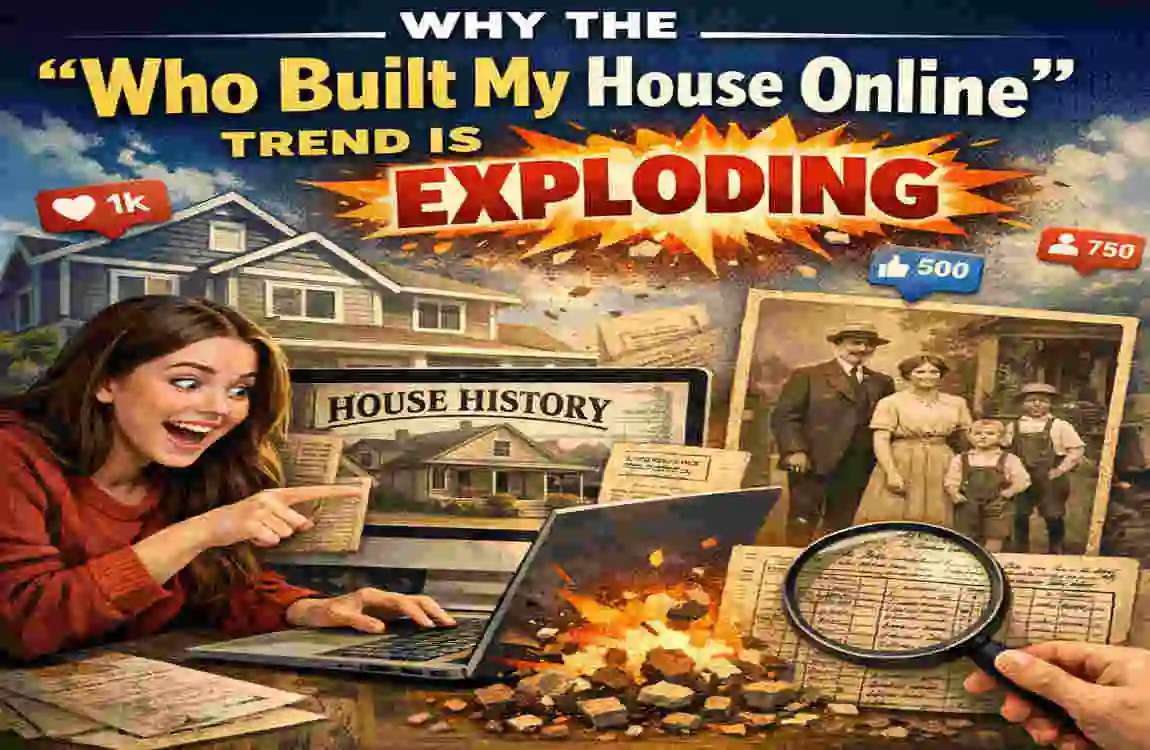
If you have spent any time on TikTok or YouTube lately, you have probably stumbled across the wildly popular hashtag challenge, #HouseBuilderReveal. This hashtag alone has racked up well over 500 million views, and the numbers are climbing daily. Users are posting dramatic, highly emotional videos revealing the shocking, funny, or historically significant people who originally built the homes they live in.
But why is this happening now? What is driving this sudden obsession with home history? We can break this down into three main driving factors: post-pandemic home pride, massive real estate data releases, and the rise of artificial intelligence.
First, let us talk about post-pandemic home pride. During the lockdowns, we all spent a massive amount of time staring at our own walls. Our homes became our offices, gyms, schools, and sanctuaries. This extended period of nesting created a deep, emotional bond between homeowners and their properties. We started to care more about the character of our living spaces. We wanted to know the story behind the creaky floorboard or the uniquely shaped window in the attic.
Second, the availability of information has never been better. In recent years, massive data leaks and open-source data dumps from real estate giants like Zillow have made historical housing information widely available. Before this, finding out who constructed your home meant spending hours in a dusty municipal basement flipping through heavy, yellowed books. Now, you can find house builder online information with just a few clicks.
Third, AI tools have completely simplified how we read and process complicated historical documents. Artificial intelligence can now scan a blurry, handwritten permit from 1912 and translate it into plain, readable text in seconds. This technology has removed the biggest barrier to entry for the average person trying to do historical research.
According to Google Trends data spanning from 2025 to 2026, there has been a staggering 300% search spike for the exact phrase “who built my house online”. Homeowner forums on Reddit and Facebook are buzzing with excitement as neighbors share tips and tricks for digging up property pasts.
Beyond just the fun and viral fame, there is a highly practical angle to this home builder history trend. Knowing the exact origins of your home is incredibly useful. It aids immensely in planning renovations, as you can match original architectural styles or know what toxic materials to avoid. It can help streamline home insurance claims by providing proof of original build quality. Furthermore, knowing your home’s unique story gives you incredible resale storytelling power when it is time to put the property back on the market.
Step-by-Step: How to Find Who Built Your House Online
Are you ready to become a property detective? You do not need a badge or a magnifying glass—just a good internet connection and a bit of patience. We have divided this complex process into understandable, bite-sized segments. Here is your ultimate guide to mastering the “who built my house online” search.
Gather Basic House Intel
Before you can uncover the deep secrets of your home, you need to start with the basics. Think of this as laying the foundation for your research. You cannot find the builder if you do not know exactly when the house was built or the legal descriptions of the land it sits on.
Your first stop should be your county assessor’s website. If you are not familiar with this term, an assessor is simply the local government official who determines the value of your property for tax purposes. Because they need to know what they are taxing, they keep highly accurate records.
Navigate to your local county assessor’s online portal and type in your address. Here, you want to pull two vital pieces of information: the exact build year and the official parcel number. You can also look at digital copies of your property deeds and tax records. These property records often list the first person to pay taxes on the land, which is a massive clue. If the first taxpayer was a local construction company, you have likely just found your builder!
Dive into Public Permits & Databases
Now that you have the basic timeline and legal numbers, it is time to dig a little deeper. You are going to search your local building departments. This is where the paper trail truly begins.
Whenever someone wants to build a house, they have to ask the government for permission. This permission is granted through public permits. These documents detail exactly who applied to build the structure, who the main contractor was, and what materials they planned to use.
For homeowners in the United States, look for your city or county’s official building and safety department online portal. Many local governments have spent the last few years digitizing their permit archives. You can often type in your address and pull up original building permits dating back to the early 1900s. If you live in the United Kingdom, the HM Land Registry is your best friend. They hold massive online databases detailing property ownership and construction histories across the country. Make sure to download and save any documents you find, as they will be crucial for the next steps!
Leverage Free Online Tools
If diving into government portals feels a little too overwhelming, do not worry! There are plenty of user-friendly, free online tools that can handle much of the heavy lifting for you. You need to know where to look and how to use them.
Start with the big real estate platforms like Zillow or Realtor.com. While most people use these sites only to buy or sell a house, they actually hold extensive historical archives. Scroll down past the current price estimates and look for the “Property History” or “Price History” tabs. Sometimes, the original listing description from decades ago is preserved here, and real estate agents love to brag about notable builders in their descriptions.
Next, open up Google Earth. This tool is an absolute goldmine for the viral house origin trend. Google Earth has a feature called “Historical Imagery.” It looks like a little clock with an arrow pointing backward. By clicking this, you can slide back in time to see satellite images of your neighborhood from years ago. If your house was built in the last thirty years, you might literally be able to see it under construction from space! You can see the layout of the builder’s trucks or the phases of the neighborhood’s development, which give you strong clues about the scale of the construction company.
Advanced Searches: Newspapers & Genealogy Sites
If you have found a name on a permit or a deed, but you do not know who that person is, it is time to get advanced. You need to switch from looking at the house to looking at the people who built it.
Your best tool here is historical newspapers. Websites like Newspapers.com allow you to search through millions of scanned pages of old local papers. Type in your address or the name of the builder you found. You will be amazed at what pops up. You might find a vintage advertisement for your housing development, complete with the construction company’s original logo and sales pitch. You can find a short article announcing the completion of your specific house!
Once you have the builder’s name, enter it into a genealogy search site like Ancestry.com. Why use a family tree site for a house? Because builders were people, too! By searching their name, you can find their builder biographies, their employment records, and maybe even connect with their living descendants. Imagine sending a message to someone saying, “Hey, your great-grandfather built my house in 1945!”
Pro Tips for Global Homes
The “who built my house online” craze is not just limited to North America. It is a massive global phenomenon. However, depending on where you live, the search might look a little different.
If you live in Europe, you need to familiarize yourself with cadastres. A cadastre is basically a highly detailed, official map used in EU countries to register property boundaries and ownership. Many European nations have placed their historical cadastral maps online, allowing you to trace your plot of land back centuries.
For our readers in South Asia, particularly Pakistan, property tracing is increasingly digitized. If you are trying to trace the origins of a beautiful colonial home in Lahore, you can now access specific provincial portals. The Punjab Land Records Authority (PLRA) has digitized centuries-old, paper-based ownership records. This allows homeowners and expats to trace the colonial-era architects who originally laid the bricks for their ancestral properties. No matter where you are in the world, the local appeal of knowing your home’s roots is universal.
Real Stories from the Trend: Shocking Reveals
It is one thing to talk about how to conduct this research, but another to see the incredible results. When you type “who built my house online” into a search engine, you are opening a digital door to the past. Sometimes, what is behind that door is utterly shocking. Let us look at a few real-life case studies that made the internet go wild.
The Florida Mob Connection. Consider the story of the Smith family in Miami, Florida. They bought a beautiful, sprawling 1920s Spanish-style estate. Curious about its sturdy architecture, they followed the steps to find a house builder online. They dug into their county records and found an obscure corporate name. Taking that name to an old newspaper database, they made a jaw-dropping discovery.
A standard contractor did not build their house. It was custom-built by an associate of the infamous Al Capone during the Prohibition era! The records showed the builder imported specific, bullet-hardened materials for the walls. Suddenly, the strange, thick basement walls in their home made perfect sense. The Smith family posted their findings on TikTok, and their story went viral overnight, garnering millions of likes.
The WWII Hero in the UK Over in the United Kingdom, a young couple in a modest London rowhouse decided to hop on the trend. They used the HM Land Registry and a genealogy search to track down the primary contractor who rebuilt their home after it was damaged during the Blitz in the 1940s.
They discovered the contractor was a decorated World War II veteran who, after returning from the front lines, dedicated his life to rebuilding his bombed-out community. He employed other struggling veterans to help frame the houses. This emotional high so moved the couple that they actually tracked down the builder’s elderly daughter and invited her over for tea to see the house her father built. It was a beautiful, viral moment that showcased the power of connecting with the past.
Tracing Colonial Roots. A fascinating story emerged from a Pakistani expat living in Canada. He inherited a crumbling but magnificent colonial-era home in the heart of Lahore. Before deciding whether to tear it down or renovate it, he used online archives and the Punjab Land Records and Survey Department to research its history.
He uncovered that the house was designed by a prominent local architect in the 1930s who blended British colonial styles with traditional Mughal designs. Armed with the original architectural blueprints he found online, the expat completely restored the home to its original glory. The house is now a local landmark.
The Lessons Learned: These stories offer incredible emotional highs but also carry lessons about potential legal pitfalls. Sometimes, uncovering your builder reveals that your home was constructed by a company known for cutting corners. If you find out your builder was sued for using faulty pipes or toxic drywall, you might suddenly realize you have defective liabilities on your hands. Knowledge is power, but sometimes that power requires you to call a plumber!
Tools & Apps Powering the Viral Searches
You do not have to do this alone. The software market has recognized the massive demand for this trend, and developers have created amazing platforms to help you. If you are ready to search “who built my house online”, here are the top tools and apps powering the craze.
Here is a quick look at the top five platforms you should have in your digital toolkit:
PropertyShark: If you live in the United States, this is a Premium powerhouse. PropertyShark aggregates data from dozens of local government sources. It consolidates property lines, ownership history, and public permits into a single, easy-to-read dashboard.
Historic England: For UK residents, this government-sponsored website is incredible. It holds millions of historic photographs, architectural drawings, and listed building data. It is the perfect place to start if your home is older than 50 years.
HouseCanary: This is where AI truly shines. HouseCanary uses advanced artificial intelligence algorithms to trace real estate histories and predict home values. It can often scrape the web for obscure building records faster than any human ever could.
Reddit and Facebook Groups: Never underestimate the power of a crowd! Local history groups on Facebook or subreddits like r/centuryhomes are filled with passionate hobbyists. You can post a picture of an old permit. Within minutes, an amateur historian will help you decode the handwriting.
Newspapers.com: As mentioned earlier, this is the ultimate tool for finding the human stories behind the bricks and mortar.
To help you decide where to spend your time and money, here is a handy breakdown of the best tools:
ToolCostBest For Ease of Use
Zillow / Realtor.com Free Quick history & basic timelines High
Reddit Communities Free Crowdsourced intel & decoding High
Newspapers.com Paid Subscription Deep dives into builder backstories Medium
Ancestry.com Paid Subscription Builder bios & family trees Medium
PropertyShark Paid (Free Trial) U.S. permits & official data Medium
Pitfalls & Privacy: Stay Safe While Digging
As exciting as it is to participate in the viral house origin trend, we must take a moment to talk about digital safety. Whenever you are dealing with public records, property data, or online searches, you need to protect yourself and respect others’ privacy.
First, we need to issue a strong warning regarding data brokers. When you search for property information, you will likely encounter websites that promise to give you “the complete history of your home” for a small fee of $1.99. Beware! Many of these sites are run by data brokers. They are not actually interested in giving you historical facts; they want your credit card information so they can harvest your data and trap you in expensive, hard-to-cancel monthly subscriptions. Always stick to official government portals or well-known, reputable sites like the ones we listed above.
You also need to be aware of the rising threat of deepfakes and AI hallucinations. Sometimes, AI tools can generate false historical documents that look incredibly real. Always verify your sources. If an AI tool tells you Abraham Lincoln built your 1990s condo, it is time to double-check that information!
Furthermore, there are crucial legal considerations regarding privacy. There is a fine line between the fair use of public records and stalking. It is perfectly legal to look up who owned your home in 1960. However, using online tools to track down the current address of the previous owner to ask them a question about the plumbing crosses a line. Respect the privacy of living individuals.
Best practices dictate that you should always use a Virtual Private Network (VPN) when doing deep public record searches to protect your own IP address and location. Stay curious, but stay safe.
Boost Your Home’s Value with Builder Knowledge

So, you have completed your “who built my house online” search. You have the permits, you know the builder’s name, and you have a great story. Now what? Well, it is time to make that knowledge work for your wallet!
Knowing your home’s origin story can directly boost its market value. When it comes time to sell, you are no longer just selling a structure made of wood and glass; you are selling a piece of history. Buyers love a good narrative. According to recent data from real estate brokerage Redfin, homes marketed with a verified, compelling historical background or notable builder pedigree can command a 5% to 10% Premium on their final sale price. If your home is worth $400,000, that little bit of online research could net you an extra $40,000!
This knowledge also provides incredible value through renovation matches. Let us say you want to restore your hardwood floors. By locating the original builder’s supply orders in the archives, you can determine exactly which species of oak they used in 1955. This ensures your renovations look seamless and authentic, which appraisers love.
Finally, do not be afraid to monetize the trend directly! If you found a great story, pull out your phone and document it. Create a TikTok or YouTube video showing your reveal. Contractors, interior designers, and real estate agents use these viral videos as massive lead generators for their businesses. Your house’s history could literally make you internet famous.
Who Built My House Online? — FAQ Guide
What does “who built my house online” mean?
It’s a popular trend where homeowners use online tools and public records to discover who originally built their home. This can reveal fascinating historical details and boost property value.
How can I start finding who built my house online?
Begin by gathering your home’s address and build year via your local county assessor or land registry website. Then, look up building permits and public records linked to your property.
Are there free tools I can use?
Yes! Websites like Zillow, Realtor.com, Google Earth, and local government portals offer free access to property histories and permits.
Is it safe to search these records?
Generally, yes. Public records are legal to access, but avoid data broker sites that charge fees or misuse your info. Use VPNs and verify sources to stay secure.
Why should I care who built my house?
Knowing your builder helps with renovations, insurance, and adds a unique story that can increase your home’s resale value by up to 10%.
Can I find builder info for homes outside the US?
Absolutely! In the UK, check the HM Land Registry and Historic England. In Europe, use cadastre maps. For Pakistan and other countries, explore local land record authorities online.
What if I uncover problems with the builder?
Use this info wisely. If you find past construction defects, consider consulting professionals to assess any risks or liabilities.