Have you ever stopped to wonder what is actually inside the walls of your home? We walk past them, hang pictures on them, and paint them, but we rarely think about their actual dimensions. You might be surprised to learn that house walls vary widely in thickness depending on their type, the materials used to build them, and even the geographical location of your home.
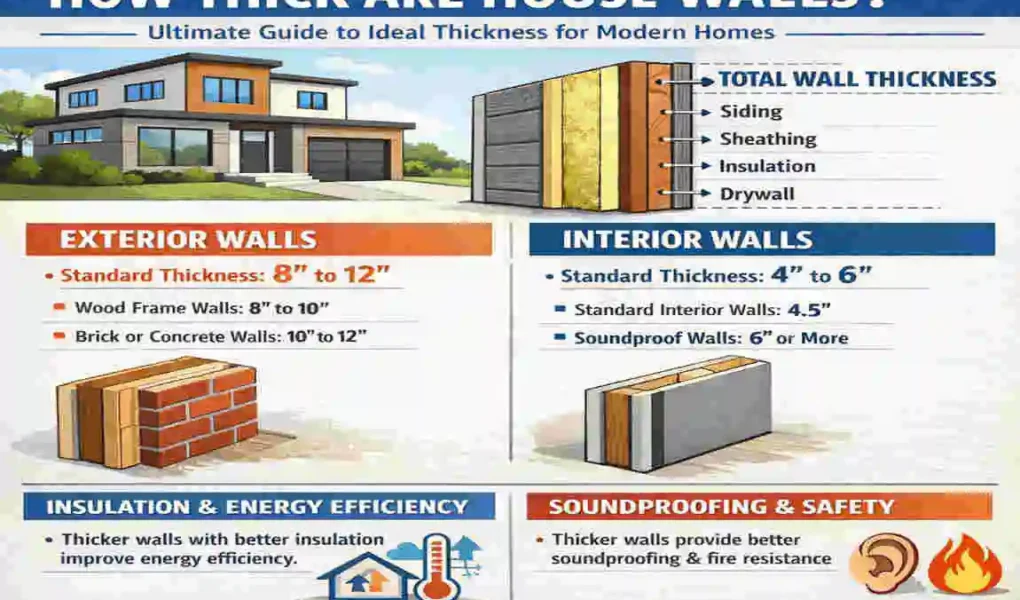
Typically, these structures range from a slender 4 to 6 inches for interior partitions to a robust 8 to 16 inches for exterior boundaries. Understanding exactly “how thick are house walls” is not just a trivia question for construction nerds. It is a vital piece of knowledge that helps homeowners, ambitious builders, and weekend remodelers optimize their living spaces for ultimate strength, cozy insulation, and maximum floor space.
| Wall Type | Typical Thickness (Inches) | Common Materials |
|---|---|---|
| Interior (Non-Load) | 4-6 | Drywall on 2×4 studs |
| Exterior | 6-12 | 2×6 studs + insulation |
| Load-Bearing | 9-16 | Brick/concrete |
Why Wall Thickness Matters
You might be asking yourself, “Why should I care about the thickness of my walls?” It is a fair question. The reality is that the dimensions of your walls play a massive role in your daily comfort and your financial bottom line.
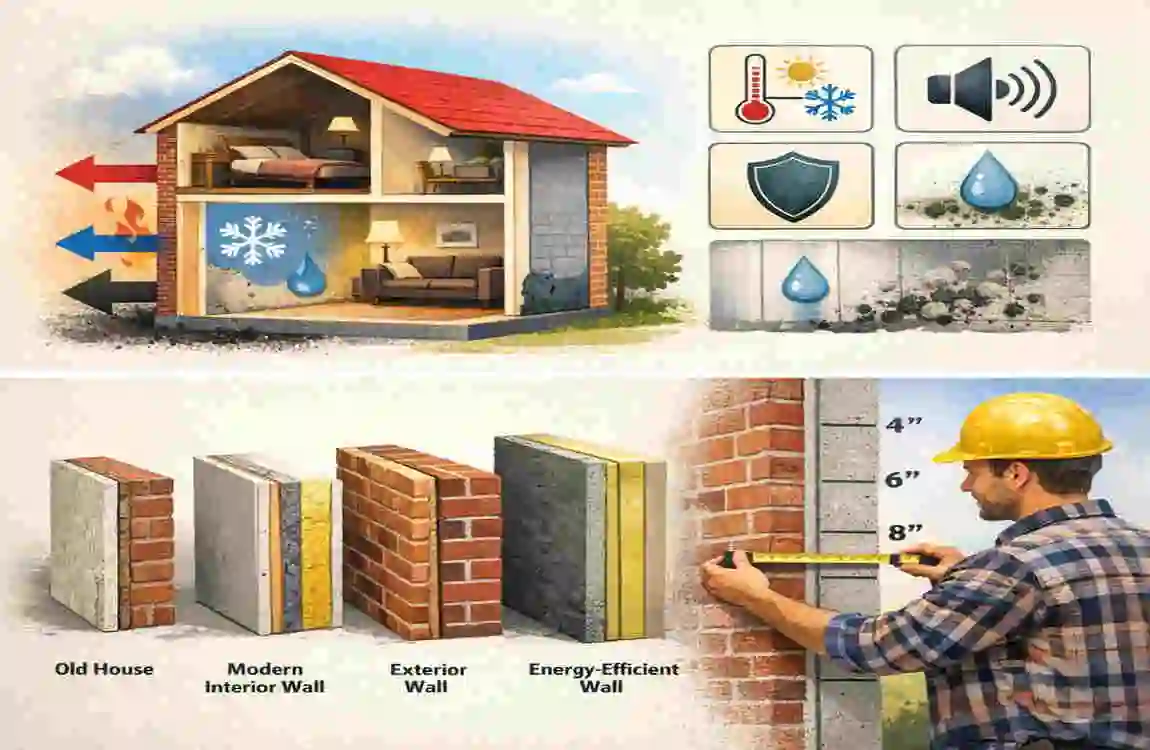
First and foremost, thicker walls significantly enhance your home’s structural integrity. They are the sturdy legs that hold up the heavy ceiling and roof above you. When a brutal storm rolls through or heavy snow piles up on your roof, you want walls that can easily carry that immense load without buckling.
Secondly, let’s talk about energy efficiency. Thicker exterior walls accommodate denser, more effective insulation. In cold climates, upgrading to a thicker wall profile can reduce your monthly heating costs by a staggering 20% to 30%. Think about that! That is money back in your pocket every single month, simply because your house wears a thicker “winter coat.” The trapped air and specialized materials inside these cavities prevent winter winds from entering and keep your heated, expensive air from leaking out.
Finally, there is the luxury of soundproofing. We all know the annoyance of hearing every footstep, conversation, or late-night television show from the next room. Properly sized and insulated walls block out this noise pollution, giving you a peaceful, quiet sanctuary. Poor choices in wall dimensions during construction inevitably lead to frustrating issues down the road, ranging from structural cracks to sky-high utility bills. Making informed decisions now is essential for the long-term durability and enjoyment of your home.
Standard Thickness by Wall Type
Not all walls serve the same purpose, and therefore, they are not built to the same dimensions. Let’s break down complex building concepts into easily understandable segments, so you know exactly what is happening in your floor plan.
Interior Non-Load-Bearing Walls
Imagine the wall separating your bedroom from your hallway, or your living room from your dining area. Most of the time, these are interior non-load-bearing walls. Their primary job is simply to partition rooms and provide privacy. Because they do not carry the heavy weight of the roof or the floor above them, they can afford to be quite slender.
Typically, these walls measure about 4 to 6 inches (10 to 15 cm) thick. In traditional wood-frame homes, builders create these partitions using standard 2×4 wooden studs. Here is a fun construction fact: a 2×4 piece of lumber does not actually measure 2 inches by 4 inches! Due to the milling and drying process, a modern 2×4 is actually 1.5 inches thick and 3.5 inches wide.
To create the finished wall, builders place these 3.5-inch-wide studs vertically and attach a 0.5-inch-thick sheet of drywall to both sides. Do the math with me: 0.5 inches (drywall) + 3.5 inches (stud) + 0.5 inches (drywall) equals exactly 4.5 inches. If you are building a house with internal brick partitions, those versions usually fall in the 5- to 6-inch range. These slim dimensions are ideal because they offer great flexibility during home renovations without eating up your precious living space.
Exterior Walls
Now let’s step outside your house. Exterior walls are your home’s primary defense against the elements. They face the blazing sun, the freezing snow, driving rain, and howling winds. Because of this massive responsibility, they range from 6 to 12 inches (15 to 30 cm) thick.
Unlike a simple interior wall, an exterior wall is a complex sandwich of materials. It includes the wooden framing, thick layers of insulation, structural sheathing, weatherproofing house wrap, and the final exterior siding or brick veneer.
In modern construction, builders frequently upgrade from 2×4 studs to 2×6 studs for exterior frames. A 2×6 board is actually 5.5 inches wide. When you add half an inch of interior drywall, half an inch of exterior plywood sheathing, and perhaps an inch of exterior siding, you easily yield a total thickness of 8 to 10 inches.
Why go thicker? The larger 5.5-inch cavity allows for thicker fiberglass or spray foam insulation, which dramatically boosts the wall’s R-value (the measure of thermal resistance). More R-value means massive energy savings for you. In certain hot, humid climates, such as Pakistan’s sweltering summers, builders often use “cavity walls.” These features have two layers of masonry with an air gap between them. This brilliant design controls moisture and stops heat from transferring into the living space.
Load-Bearing Walls
These are the heavy lifters of your home. Load-bearing walls literally support the immense weight of your roof, or if you live in a two-story home, the entire second floor. You absolutely cannot remove these walls during a DIY remodel without bringing your house down!
Because of the massive forces pushing down on them, load-bearing walls require serious structural muscle. They typically range from 9 to 12 inches (24 to 30 cm) thick, especially when built with solid brick, concrete blocks, or heavily reinforced wood frames.
In large, multi-story buildings, these walls might feature even thicker profiles, sometimes reaching up to 16 inches to safely handle the accumulated loads, exactly as required by strict building codes. Whenever you are planning to modify a wall that you suspect might be holding up the house, always consult a licensed structural engineer to guarantee your safety.
Here is a handy reference guide to summarize the different types:
Wall Type: Typical Thickness (Inches)Common Materials: Key Benefit
Interior Non-Load 4 – 6 inches Drywall on 2×4 wooden studs. Highly space-efficient for floor plans
Exterior 6 – 12 inches 2×6 studs, heavy insulation, siding , superior energy efficiency, and weather protection
Load-Bearing 9 – 16 inches Brick, Concrete blocks, Reinforced framing Unmatched structural strength and safety
Factors Influencing Thickness
So, who decides whether your wall will be a skinny 4 inches or a bulky 12 inches? It is not a random guess. Builders consider three major factors before laying a single brick or cutting a single piece of wood.
Building Materials
The materials you choose fundamentally dictate the final footprint of your walls. Standard drywall and wood framing stay exceptionally slim. As we calculated earlier, a standard interior partition is about 4.5 inches.
However, if you love the rustic charm and durability of masonry, you have to sacrifice more space. A standard brick wall requires about 5 to 6 inches of thickness per single layer. If you are building a double-brick exterior cavity wall, you are easily looking at 10 to 12 inches.
Modern builders also love using ICF (Insulated Concrete Forms). Think of these like giant, adult-sized Lego blocks made of thick foam. Builders stack them up and pour solid liquid concrete into the hollow center. The foam stays in place permanently as insulation. Because you have foam on the outside, concrete in the middle, and foam on the inside, an ICF wall can easily reach 12 inches or more. They offer absolutely incredible insulation and can withstand hurricane-force winds.
You also have to consider local availability. In many parts of South Asia, builders use specialized lightweight bricks measuring 8 to 10 cm thick, allowing for slightly thinner but very strong masonry partitions.
Climate and Location
Mother Nature has a huge say in how thick your walls need to be. The climate you live in completely changes the required building strategy.
Let’s say you live in a hot-humid area, like Lahore. Builders in these regions often favor 8 to 10-inch exterior walls specifically designed to incorporate ventilation gaps. These gaps allow trapped heat to escape and prevent moisture from rotting the interior structure. The thickness acts as a “thermal mass,” absorbing the intense daytime heat and slowly releasing it at night as it cools.
Conversely, if you live in a freezing-cold region, you demand heavily insulated exteriors of 10 to 12 inches. You need that massive physical cavity to fill with high-density insulation to keep the cold out.
Location also means looking at the ground beneath your feet. If your home is located in an active seismic zone (an area prone to earthquakes), your walls cannot just be thick; they must be flexible and heavily reinforced with steel rebar. These vital seismic reinforcements often add an extra 2 to 4 inches to the wall thickness, keeping you safe when the ground shakes.
Building Codes and Regulations
You cannot just build whatever you want, wherever you want. Every city and municipality has strict building codes and regulations. These rules are written in blood—they exist to ensure homes do not collapse, catch fire easily, or freeze their occupants.
Standards vary dramatically across the globe. US residential codes generally mandate a minimum 2×4 framing for interiors, setting the baseline thickness. In the European Union, there is a strong emphasis on reducing carbon footprints. Therefore, EU codes often require heavily insulated exterior walls, reaching 20 to 25 cm (roughly 8 to 10 inches) thick.
Modern Trends in Wall Thickness
The construction industry is not stuck in the past. We are constantly seeing exciting modern trends that push the boundaries of how we build our living spaces.
Today, the biggest push is toward the energy-efficient home. In the past, 2×4 exterior walls were the norm. Today, builders overwhelmingly use 2×6 studs for exteriors, pushing the total thickness past 10 inches. This extra two inches of depth allows builders to install R-20 or even R-22 insulation, trapping heat brilliantly and slashing carbon emissions.
We are also seeing the rise of highly sustainable building options, such as SIPs (Structural Insulated Panels). Imagine a giant ice cream sandwich, but instead of cookies, it is two sheets of strong engineered wood. Instead of ice cream, it is a dense, rigid foam core. These panels are manufactured in a factory and shipped to the building site. SIP walls offer high performance, airtight insulation, and incredible strength, typically measuring between 6 and 8 inches thick.
Finally, let’s look at the tech world. Smart homes are changing the physical structure of our houses. Homeowners want hidden speakers, automated window blinds, central vacuum systems, complex security sensors, and miles of networking cables. Integrating all of this technology cleanly requires thicker wall cavities to hide the wires and hardware, ensuring your high-tech home still looks sleek and beautiful.
Measuring Wall Thickness Accurately
So, how can you figure out what is going on in your own house? You do not need to tear down the plaster to find out! Measuring wall thickness accurately is something any homeowner can do with a few simple tricks.
The easiest method is to go to any open doorway in your home. Look at the door jamb—the flat piece of wood that lines the inside of the doorway. The width of this jamb (excluding the decorative trim molding on the outside) is an almost perfect representation of your wall’s total thickness. Grab a simple tape measure and stretch it across the jamb. If it reads roughly 4.5 to 5 inches, you are looking at a standard 2×4 interior partition.
If you are looking at an architectural floor plan, you can read the lines. Drafters and architects use visual cues to guide builders. Bold, heavy lines usually represent thick exterior boundaries (6-12 inches), while thin, lighter lines denote slender interior partitions (4-6 inches).
For those looking to do serious renovations, professionals use a stud finder or even drill a tiny, hidden test hole to measure from the inside out. Today, high-tech contractors use advanced laser-measuring tools to map precise wall thicknesses across an entire house in minutes, ensuring perfection during complex remodeling jobs.
Common Myths Debunked
The world of home improvement is full of old wives’ tales and bad advice. Let’s clear the air and debunk the most common myths about wall dimensions.
Thicker is always better.Reality: Building a massive, fortress-like 12-inch wall is the best route. However, excess thickness actually wastes your valuable interior living space. If you build 12-inch walls inside a small urban apartment, you will have no room left for furniture! For most modern homes, a well-insulated 6-inch to 8-inch exterior wall is more than sufficient to provide exceptional strength and weather resistance without eating up your square footage.
All interior walls are exactly 4 inches thick.Reality: While 4.5 inches is the standard for modern drywall, thickness varies drastically based on the final finish. If you live in an older home with traditional lath-and-plaster walls, that thick, heavy plaster can easily add 1 to 2 inches to your interior walls. Additionally, walls hiding heavy plumbing pipes (like the wall behind your toilet or shower) are often built using thicker 2×6 studs to accommodate the wide drain pipes.
Old, historic homes always have thicker walls than modern homes.Reality: This is only partially true. If you are looking at an ancient masonry or stone house from the 1800s, yes, those walls might be a foot thick or more! However, if you are looking at a historic wood-framed home from the 1920s, the studs and framing techniques used are actually very similar to modern specifications. In fact, modern homes often have thicker wood-framed walls to accommodate heavy insulation.
Benefits of Optimal Thickness
Why go through the trouble of getting this right? The benefits of nailing the optimal wall thickness are truly life-changing for a homeowner.
First, let’s talk about the money. Proper wall sizing and the resulting insulation can cut your monthly energy bills by 15% or more. Over the 30-year lifespan of a mortgage, that adds up to tens of thousands of dollars in savings. It perfectly balances the initial construction cost—upgrading from 2×4 to 2×6 studs might cost an extra $5,000 during the build. Still, it saves you $500 every single year on utilities. The upgrade literally pays for itself.
Next is the vastly improved acoustics. A home should be a peaceful retreat. Thicker walls absorb sound waves, preventing the noise of your washing machine from ruining your movie night in the living room.
Finally, optimal dimensions boost your home’s resale value and physical safety. Thicker exterior assemblies naturally resist violent storms, heavy impacts, and high winds. If you live in a hurricane or flood-prone area, having that extra beefy exterior wall might be the difference between minor damage and a total structural loss. Buyers know this, and they will pay a premium for a home built to high standards.
DIY Tips for Homeowners
Are you ready to roll up your sleeves? If you are a handy homeowner planning a weekend project, here are some practical tips for your walls.
Before you start knocking down walls to create an open-concept kitchen, you must inspect the walls to see what kind they are. Give the wall a firm knock with your knuckles. If it sounds high-pitched and hollow, it is likely a standard 4.5-inch non-load-bearing partition. If it sounds deep, solid, and immovable, you might be knocking on a load-bearing structure. Never swing a sledgehammer until you know for sure!
If you are building a new closet or framing a basement room, frame your interior walls to match the standard 4.5-inch thickness. Buy standard 2x4s and half-inch drywall. Sticking to these standard dimensions ensures that standard pre-hung doors and trim molding will fit perfectly without expensive custom modifications.
What if you have thin, poorly insulated walls but don’t want to do a major demolition? You have options! You can insulate thin walls with blown-in cellulose. Professionals can drill tiny, easily patchable holes at the top of your drywall and literally blow fluffy insulation down into the thin wall cavities, drastically improving your home’s temperature control without tearing the house apart.
Case Studies: Real Homes in Action
To truly understand how this works, let’s look at how builders apply these concepts in the real world across different continents and climates.
The South Asian Urban Build: Consider a beautiful new home built on a standard 50×90-foot plot in Lahore, Pakistan. To maximize boundary security and structural stability in the two-story design, the architects utilized robust 9-inch solid brick boundary walls and load-bearing walls. However, to ensure the interior rooms felt spacious and airy, they lowered the non-load-bearing partitions to slim 6-inch single-brick layouts—this perfectly balanced ultimate structural safety with a comfortable living space.
The North American Eco-Home: In the chilly climate of the US Midwest, a family wanted to build a hyper-efficient modern home. Instead of traditional framing, they specifically requested 2×6 exterior walls. By filling that deep 5.5-inch cavity with high-density spray foam, they achieved an incredible R-21 insulation rating. The result? The homeowners reported a massive 30% reduction in winter heating bills compared to their neighbors living in older, thinner-walled homes.
The Australian Coastal Retreat: Over in Australia, builders frequently use “brick veneer” construction to battle the fierce coastal weather and heat. A recent home build featured an exterior structural wooden frame wrapped in insulation, an air gap, and, finally, a beautiful outer skin of exposed brick. This entire complex system created an incredibly durable 9.5-inch exterior wall. Inside, however, they kept things light and breezy with standard 4-inch timber-framed internal partitions.
Cost Breakdown of Wall Upgrades
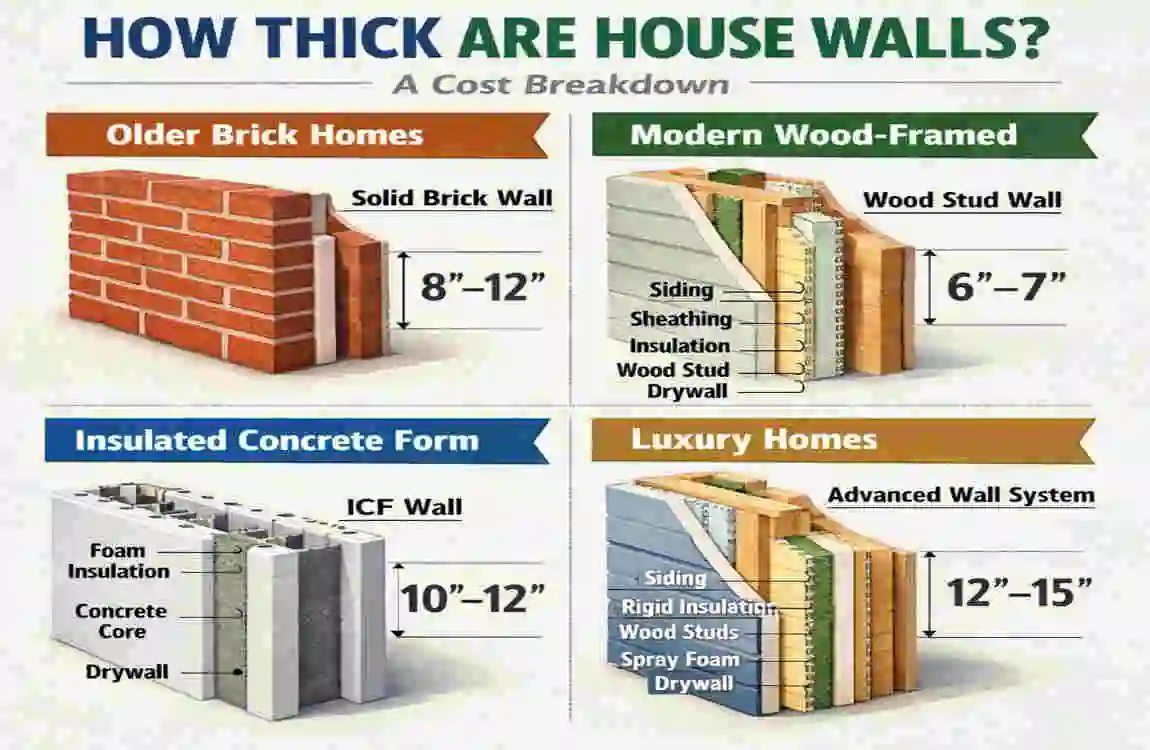
Let’s talk numbers. Changing the thickness of your walls changes the amount of wood, brick, drywall, and insulation you have to buy. It also changes the amount of time the construction crew has to spend building it. Here is a helpful breakdown of what you can expect when budgeting for different wall thicknesses.
Thickness Upgrade Material Cost (per sq ft)Labor Cost (per sq ft)The Long-Term Return on Investment
Standard 4-6″ (Basic 2×4 framing, minimal insulation) $2 – $4 $1 – $2 This is your baseline. It is cheap to build but offers no special energy savings.
Optimal 8-10″ (2×6 framing, high-density insulation) $4 – $7 $2 – $4 High Value: You will easily save $300+ a year on energy, paying off the upgrade quickly.
Premium 12″+ (ICF, Double Masonry, Extreme Climate) $8 – $12 $4 – $6 Maximum Durability: 25% more durable against extreme weather, yielding incredible resale value.
As you can see, jumping from a standard 4-inch wall to an optimal 8-inch wall doubles your upfront material cost. However, the long-term energy savings make the “Optimal” route the smartest financial choice for almost any new homeowner.
FAQs about how thick house walls typically are:
How thick are standard house walls?
Most interior walls are about 4–6 inches (10–15 cm) thick, while exterior walls are usually 6–12 inches (15–30 cm) thick depending on materials.
Why are exterior walls thicker than interior walls?
Exterior walls include insulation, structural framing, and weather protection, making them thicker than simple interior partitions.
How thick are brick house walls?
Brick walls are typically 9–12 inches (23–30 cm) thick, but older homes may have even thicker solid masonry walls.
How thick are concrete walls in houses?
Concrete walls usually range from 6–10 inches (15–25 cm) thick, depending on structural needs.
Are modern house walls thinner than older homes?
Yes, modern homes often use lighter materials like drywall and timber framing, making walls thinner than traditional solid masonry walls.
How thick are load-bearing walls?
Load-bearing walls are generally thicker, often 6 inches or more, to support structural weight.