When you start looking for a home, you quickly notice that real estate has its own language. Agents, builders, and brochures often talk about carpet area, built-up area, and super built-up area as if everyone already understands the difference. But many homebuyers do not. And honestly, that confusion is completely normal.
If you have ever wondered what carpet area is in a house, you are already asking the right question. This one number can change how you see a property. It tells you how much usable space you actually get inside your home. That matters a lot because a house may look big on paper, but still feel cramped once you move in.
Understanding carpet area also helps you compare homes more fairly. Two flats may have the same advertised size, but one may offer much more practical space inside. That difference can affect your comfort, your furniture layout, and even your long-term satisfaction with the home.
What Is Carpet Area in a House? 
Simple meaning of carpet area
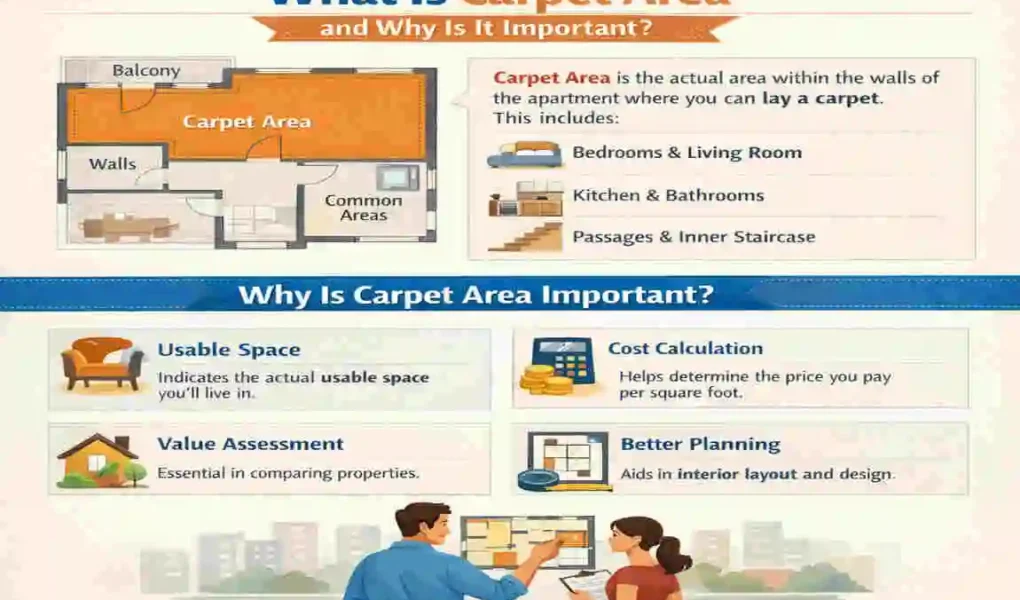
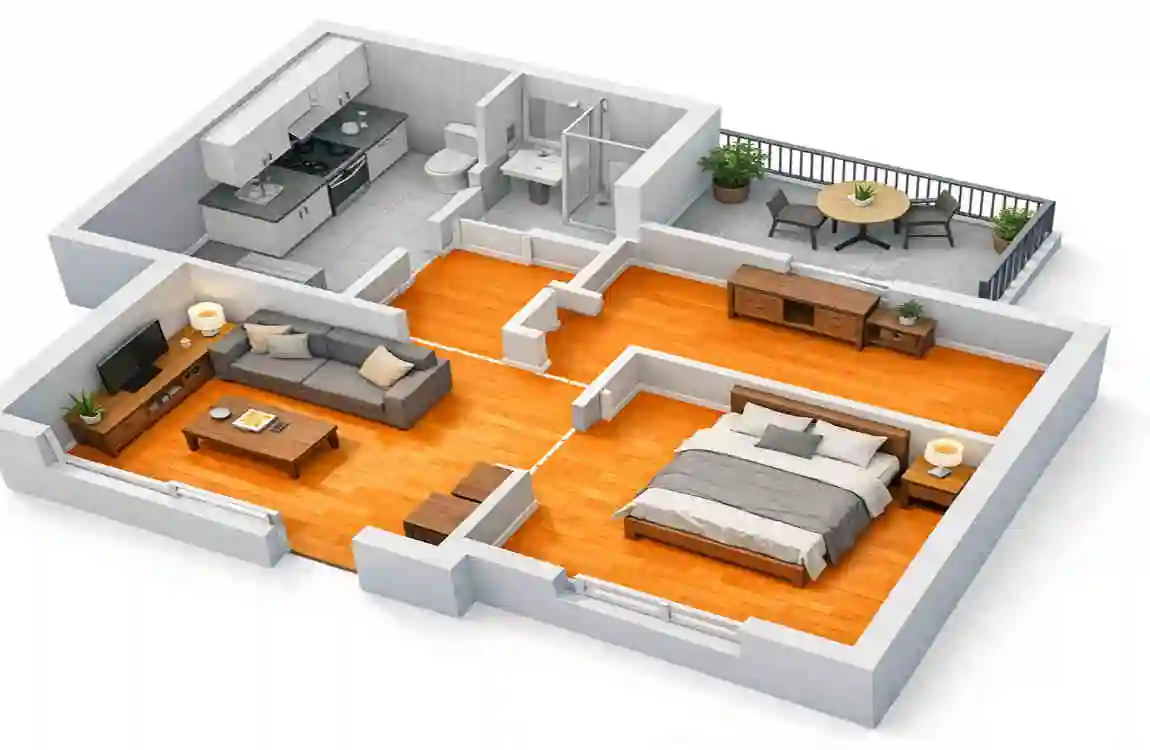
The carpet area of a house is the actual usable floor space inside the walls. It is the area where you can walk, place furniture, and live your daily life. The name comes from the idea that it is the part of the floor where you could literally lay a carpet.
In very simple terms, carpet area is the space that belongs to you and that you can use inside your home. It does not include the thickness of the walls, the balcony, the terrace, or shared areas outside the apartment.
This is why carpet area is such an important number. It tells you the space you can truly use, not just the space a brochure may advertise.
Think about it this way. If a flat is shown as 1,000 square feet, that does not always mean you get 1,000 square feet of usable room inside. Some of that size may be taken up by walls, shafts, passages, and shared parts of the building. Carpet area cuts through that confusion and gives you the real usable figure.
What is included in the carpet area?
The carpet area usually includes the parts of the home where you live and move around every day. These often include:
- Bedrooms
- Living room
- Dining area
- Kitchen
- Bathrooms
- Toilets
- Internal passages
- Internal staircases in some homes
This means if you can stand on it, walk on it, place furniture on it, or use it as part of your everyday life, it is likely part of the carpet area.
However, the exact interpretation can vary slightly depending on local rules and property type. In most residential properties, the core idea remains the same: carpet area is the usable indoor floor space.
You can think of it as the practical heart of your home. It is the space that matters when you are arranging a sofa, setting up a bed, or planning where the dining table should go.
What is not included in the carpet area?
Just as important as knowing what is included is knowing what is excluded. The carpet area does not include parts of the home that are not directly usable as living space.
Usually, these are excluded:
- Balcony
- Terrace
- External walls
- Lift area
- Common corridors
- Staircase used by the building
- Shared lobbies
- Utility shafts
- Verandas in many cases
This is where many buyers get confused. A house may appear spacious because it has a large balcony or a wide common area, but those parts do not count in the carpet area. So, if you want to know how much room you really have for your daily life, the carpet area is the number that matters most.
Why the term matters so much
The term carpet area may sound technical, but the idea behind it is simple. It helps you understand the real usable size of a home.
That matters for several reasons. First, it helps you judge whether a property is worth the asking price. Second, it helps you plan your interiors properly. Third, it protects you from misleading sales claims.
If you only look at the total advertised size, you may end up paying for space you cannot really use. A carpet area helps you avoid that mistake.
Carpet Area vs Built-Up Area vs Super Built-Up Area
One of the biggest challenges for homebuyers is understanding the difference between these three terms. They may sound similar, but they are very different in meaning and value.
Carpet area
This is the actual usable space inside the home. It is the most practical measurement because it tells you how much room you have for daily life.
If you want to know how spacious a home really feels, the carpet area is the best number to check first.
Built-up area
The built-up area includes the carpet area plus the thickness of the walls and, in some cases, utility spaces such as ducts or small ledges.
So, the built-up area is always larger than the carpet area.
Why does this matter? Because the extra space is not fully usable like a room floor. A wall takes up space, but you cannot place a sofa inside it or walk through it. That is why the built-up area is less useful for judging actual livability.
Super built-up area
Super built-up area goes beyond the built-up area. It includes the apartment’s share of common areas such as:
- Lobby
- Staircase
- Elevator space
- Shared corridors
- Clubhouse or amenity spaces in some projects
This is often the number builders advertise most because it looks bigger. But from a buyer’s point of view, it can be misleading if you do not know what is behind the number.
A home may look large in super built-up terms, but the actual usable space inside may be much smaller.
Why do buyers get confused
Most confusion happens because these terms are often used casually in sales conversations. A buyer hears a large square footage number and assumes that all of it belongs to the apartment. But that is not true.
Here is the simple rule:
- Carpet area = usable inside space
- Built-up area = usable space + walls
- Super built-up area = built-up area + shared spaces
Once you understand this difference, you can stop comparing homes based on marketing numbers alone and start comparing them based on real value.
Key differences table
Measurement TypeWhat It IncludesWhat It ExcludesWhy It Matters
Carpet Area Usable indoor floor space Walls, balcony, terrace, common areas Shows actual living space
Built-Up Area Carpet area + walls + some service spaces Shared building spaces Gives a broader size estimate
Super Built-Up Area Built-up area + common areas like lobby and corridor share Actual exclusive usable space Often used for marketing, but less accurate for buyers
Which one should matter most to you?
If you are buying a home, the carpet area should matter most. It tells you what you can truly use. Built-up area and super built-up area may still appear in documents and sales sheets, but carpet area is the best way to measure real comfort and practical space.
That does not mean the other measurements are useless. They do have a purpose. But when you are comparing two homes, carpet area gives you the clearest picture.
How to Calculate Carpet Area
Basic formula
The basic idea is very simple:
Carpet Area = Usable floor area inside the walls
In a practical sense, you calculate the area of each usable room and then add them together.
The usual formula for each room is:
Length × Width = Area
Then you add the areas of all the included spaces.
Step-by-step calculation
Let’s break it down in a simple way.
Measure each usable room
Take a measuring tape and note the length and width of each room that counts toward the carpet area.
For example:
- Bedroom: 12 ft × 10 ft
- Living room: 15 ft × 12 ft
- Kitchen: 10 ft × 8 ft
- Bathroom: 6 ft × 5 ft
Calculate each room’s area
Now multiply length by width:
- Bedroom: 12 × 10 = 120 sq ft
- Living room: 15 × 12 = 180 sq ft
- Kitchen: 10 × 8 = 80 sq ft
- Bathroom: 6 × 5 = 30 sq ft
Add the usable areas
Now add all of them together:
120 + 180 + 80 + 30 = 410 sq ft
So the carpet area of this simple example is 410 square feet.
Example with a sample house layout
Let us imagine a small apartment with the following spaces:
- Master bedroom: 14 × 12 = 168 sq ft
- Second bedroom: 11 × 10 = 110 sq ft
- Living room: 16 × 12 = 192 sq ft
- Kitchen: 9 × 8 = 72 sq ft
- Two bathrooms: 2 × 30 = 60 sq ft
- Passage area: 5 × 6 = 30 sq ft
Now add them:
168 + 110 + 192 + 72 + 60 + 30 = 632 sq ft
In this example, the carpet area is 632 square feet.
If the builder says the built-up area is 720 sq ft and the super built-up area is 900 sq ft, you can now see the difference clearly. The real usable area is much smaller than the advertised total.
A few important things to remember
When calculating carpet area, keep these points in mind:
- Measure inside the walls, not outside them
- Include only usable floor space
- Do not count balconies or common spaces
- Check the floor plan carefully
- Ask the builder or seller for the official carpet area in writing
This may seem like a small detail, but it can make a big difference when you compare properties.
Importance of Carpet Area in Real Estate
Helps in price comparison
One of the biggest reasons carpet area matters is simple: it helps you compare prices properly.
A home may look cheaper at first because the total advertised area is large. But if most of that size is common space or wall thickness, the actual usable space may be poor. That means the real value may not be as good as it first appears.
If you compare homes based on price per square foot of carpet area, you get a more accurate picture. This helps you see whether one property truly gives you more usable space for your money.
For example, two apartments may both cost the same. But if one has more carpet area, one is getting more livable space for the same price. That is a better deal.
Avoids misleading marketing
Let us be honest: property marketing can be very creative. Builders want to present homes in the best possible light, and one way they do that is by highlighting the biggest area number available.
That is why many advertisements focus on a super built-up area. It makes the home seem larger than it really is.
If you do not understand carpet area, you may feel impressed by the headline size and overlook the actual usable space. Later, when you move in, the apartment may feel smaller than expected.
Knowing the carpet area protects you from that kind of disappointment.
Better space planning
Carpet area is not just about money. It also helps you plan your home better.
If you know the actual usable space, you can make smarter decisions about:
- Furniture size
- Storage units
- Bed placement
- Dining table fit
- Walking space
- Interior design layout
This becomes especially useful in smaller homes. Even a few extra square feet can change how a room feels. A space that looks big on paper may still feel cramped if the layout is poor. Carpet area helps you understand the real usable dimensions before you buy.
Legal transparency
In many places, especially where RERA applies, builders must clearly disclose the carpet area of a property. This is a major step forward for buyer protection.
Why? Because it forces more honesty in the selling process.
When the law requires builders to mention carpet area clearly, it becomes easier for buyers to compare homes fairly and avoid confusion. That means fewer surprises later.
The practical value for you
When you know the carpet area, you gain control. You can ask better questions, compare properties more intelligently, and avoid buying space that only looks large.
That is why this number matters so much in real estate. It is not just a technical detail. It is a tool that helps you buy with confidence.
Carpet Area as per RERA Rules
What RERA says
Under RERA — the Real Estate Regulatory Authority framework in many regions — carpet area is defined as the net usable floor area of an apartment, excluding the area covered by external walls, service shafts, exclusive balcony or verandah areas, and exclusive open terrace areas.
That definition matters because it gives a standard way to measure space. Without a standard, builders could use different methods and confuse buyers even more.
Builder obligations
Builders are usually required to:
- Clearly mention the carpet area in the agreement
- Avoid misleading area claims
- Provide accurate project details
- Explain how the area was calculated
This improves transparency and protects the buyer from false or inflated measurements.
Buyer protection benefits
RERA-based carpet area rules help buyers in several ways:
- They make property comparison easier
- They reduce the chance of hidden surprises
- They improve trust between buyer and builder
- They support fair pricing
- They create better legal clarity in property documents
For homebuyers, this is a big win. It means you can focus on the real size of the home, not just the marketed size.
If you are reviewing a property, always check whether the carpet area is listed clearly in the official documents. Do not rely only on sales talk.
Common Mistakes Buyers Make
Even smart buyers make mistakes when they do not fully understand area measurements. Here are some of the most common ones.
Confusing carpet area with built-up area
This is the biggest mistake. Many buyers assume that all area numbers mean the same thing. They do not.
If you mistake a built-up area or a super built-up area for carpet area, you may overestimate how much usable space you are getting. That can lead to disappointment later.
Not verifying agreement details.
Some buyers trust the brochure but forget to check the official sale agreement. That is risky.
Always verify:
- Carpet area
- Built-up area
- Super built-up area
- Floor plan
- Area calculations in the agreement
The written agreement matters more than a sales pitch.
Ignoring layout efficiency
A home with a decent carpet area can still feel awkward if the layout is poor. For example, a long, narrow room may be harder to furnish than a more balanced room of the same size.
So do not look at the carpet area alone. Also check how the space is shaped and arranged.
Other common errors to avoid
Here are a few more mistakes to watch out for:
- Assuming balcony space is included
- Ignoring wall thickness
- Focusing only on the total square footage
- Not asking for a clear floor plan
- Comparing homes without using the same measurement type
These mistakes are easy to make, but they are also easy to avoid once you know what to look for.
Tips for Homebuyers

Always ask for the carpet area.
When you speak with a builder or agent, make it a habit to ask for the carpet area first. This should be one of your first questions, not your last.
If someone avoids giving you a clear answer, that is a warning sign.
Compare homes using usable space.
Do not compare homes only by price or total area. Compare them by usable space. A smaller apartment with better carpet area may be more valuable than a larger one with less usable floor space.
Check the floor plan carefully.
A floor plan tells you how the space is arranged. This is important because a well-planned home can feel more spacious than a poorly planned one with the same area.
Look at:
- Room sizes
- Passage widths
- Position of bathrooms
- Kitchen placement
- Furniture fit
- Natural movement through the home
Verify with RERA documents.
If the project is under RERA, check the official details carefully. These documents can help you confirm the carpet area and understand what you are really buying.
Simple homebuyer checklist
- Ask for the carpet area in writing
- Compare the price per square foot of carpet area
- Review the floor plan
- Check if the balcony and walls are excluded
- Read the sale agreement carefully
- Do not rely only on brochure numbers
These small steps can save you from a costly mistake later.
FAQs
What is the carpet area in a house in simple words?
The carpet area is the actual usable area inside your home. It is the space where you can place furniture, walk around, and live comfortably.
Does the carpet area include walls?
No, walls are not included in the carpet area. Both internal and external walls are excluded from the usable floor space measurement.
Is the balcony included in the carpet area?
No, balconies are not part of the carpet area. They are usually excluded because they are not considered usable indoor floor space.
Why is the carpet area smaller than the built-up area?
The carpet area is smaller because the built-up area includes the carpet area plus walls and some structural spaces. Since those parts are not fully usable, the built-up area is always larger.
Which is better to compare homes—carpet area or super built-up area?
The carpet area is better for comparing homes because it shows the actual usable space inside the apartment. A super built-up area includes shared building spaces and can be misleading.
Does the carpet area include bathrooms and kitchens?
Yes, in most cases, bathrooms and kitchens are included because they are usable indoor spaces within the house.
Why do builders use super built-up area?
Builders often use a super built-up area because it makes the property look larger on paper. But for buyers, it is less useful than carpet area because it includes shared spaces.
How can I check the carpet area before buying?
You can ask the builder for the carpet area in writing, review the floor plan, and verify the details in the sale agreement or RERA documents if the project is registered.
| Aspect | Explanation |
|---|---|
| Carpet Area | The actual usable floor area inside a home where you can lay a carpet. It includes bedrooms, living room, kitchen, and bathrooms, but excludes walls, balconies, and common spaces. |
| Simple Meaning | It is the “net usable space” you get inside your apartment or house. |
| Why It Matters | Helps buyers understand how much livable space they are actually getting, not just the total built-up size. |
| Difference from Built-up Area | Built-up area includes walls and other structures, while carpet area only includes usable internal space. |
| Impact on Price | Property price per square foot is more accurate when based on carpet area. |
| Buyer Benefit | Prevents confusion and ensures fair comparison between different properties. |
| Legal Importance | In many real estate regulations, sellers are required to disclose carpet area for transparency. |